'We're Here to Love One Another'
- Dec 11, 2025
- 7 min read
Rev. Ali Hager is the first female pastor in the 267-year history of West Avon Congregational Church.

By Carl Wiser
Staff Writer
When she started in June, Rev. Ali Hager became the first female pastor in the 267-year history of West Avon Congregational Church. She says delivering her one-hour sermon every Sunday at 10 a.m. is the easiest part of her week, but preparing for it takes about 15-20 hours. In addition to writing the sermon, she works with the staff on the music, the "children's moment," and the Children's Chapel (formerly known as Sunday School).
"All of that is a little less than half of the week, and then the rest is connecting with the church community," she says. "Checking on them: How are you doing? How are you feeling? Can we find a way to help you feel connected if you can't physically get here? And then working with this incredible connection of people all throughout the church who want to help that person feel like they matter, like we're thinking about them. That takes a lot of time, and it's very intentional. Those little ways of connecting fill a lot of my week.
"A lot of people wonder, why do people still go to church? Is this relevant? And I think a big piece of that is belonging to something bigger that's not just about yourself or your own immediate needs. It's what happens when we come together and we care about each other."
Undoing the "Toxic Rhetoric"
"We live in a really challenging moment," Hager says. "I really believe in communities coming together even though they don't all think the same thing or believe the same thing, and that's what we have here. We have people who have different lives and different perspectives and different backgrounds, and come from different places and probably watch different news channels. So the most challenging part is speaking to the community in a way that is about the Gospel of Jesus, which is really about 'love God, love neighbor'... end of story.
"So, taking it out of the partisan context and putting it into a context of faith, I try to do that with every step, and that's challenging because I think the larger media landscape is profiting from divisive, toxic rhetoric. I'm trying to undo some of that.
"I think a lot about the words that I use. I try to avoid symbols whose meanings have changed. For example, the word 'alien' appears in so many of our scriptures, where it's used interchangeably sometimes with 'neighbor' or 'stranger.' But in our media right now it's about 'illegal aliens.' So I either find a different translation that uses a different word, or use the translation as it exists and then find a way to teach what the word means in its original first-century context. So much of my time and effort goes into these mental processes, which I think are really important because I'm pushing against this idea of 'illegal alien.' The Bible that I claim tells us to invite the alien in, and that is risky rhetoric in this particular moment."

Academic and Spiritual Journey
Hager grew up in Indianapolis, where she graduated from high school in 1997. She spent a year studying music at DePauw University, then enrolled at Northwestern University, where she graduated in 2001 with a degree in English. Northwestern was where she met Chris, her future husband. They stayed in Chicago for a year, then moved to Rochester, New York, where Ali enrolled as a PhD student in English but "learned pretty quickly I did not want to be a PhD student." She ended up getting a master's, and in 2008 she landed in Connecticut when Chris got a job at Trinity College. Ali taught composition ("that required first year course everybody hates") as an adjunct professor at Trinity and the University of Hartford. She became a certified yoga teacher and had two daughters that she raised at home because daycare is crazy expensive.
Theology didn't come into play until Hager's grandmother died. "It was crystal clear to me that I needed to go to seminary," she says. "It was something that never occurred to me. I come from a very academic family - I was not raised in a specific religious tradition. My family's Italian, so Catholicism was on the periphery."
In fact, her dad was "very anti-church." It was her grandfather who took Ali to services.
"When I was 13 I asked if I could go to mass with him, and that was the beginning of regular spiritual life for me. I went through the process and was confirmed Catholic, all of my choosing."
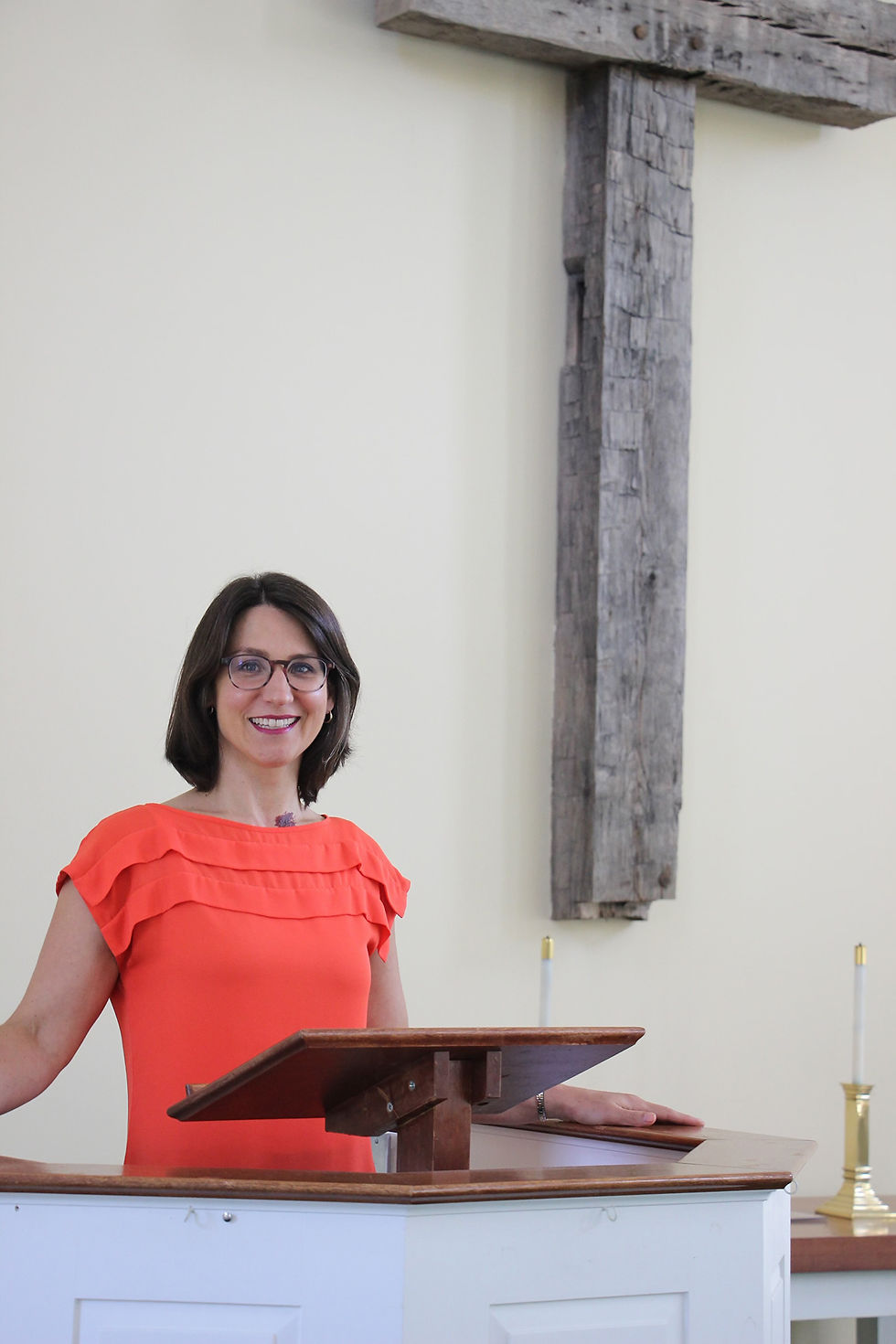
Hager was drawn to the "quiet faith" of her grandfather and great-aunt.
"My great-aunt was this tiny Italian woman, and whenever she would come to visit, she would sit in the living room with her rosary beads. It was clear that she was praying as she was sitting there with her beads, and that living room was like this force field of peace. It was just beautiful, and I thought, I want to do that."
In her college years, Hager looked for "a place that felt like a good spiritual home."
"I knew that Catholicism wasn't the right fit for me, but I didn't have the understanding of why," she says.
In 2019 she went part-time to Hartford Seminary (now Hartford International University), working around her kids' schedules. After two years, she transferred to Yale Divinity School, where she graduated with a Master of Divinity in 2024.
"It takes all of you," she says of Yale Divinity. "You get pushed. You have to deconstruct your theology and then put it back together again, and for some people during that process of deconstruction, it's like, 'I'm out of here. I can't do this.' And for others, it's the most life-giving thing imaginable because they can put it back together in a way that allows them to be who they are. That just blew me away.
"It's eye-opening what Christianity can be and what it can look like. How diverse and life-giving it can be, and also how incredibly damaging it can be. Many people show up there completely wrecked by religious trauma. They show up there trying to figure out if there's anything salvageable. It was truly one of the great privileges of my life to watch people navigate through that and to have them accept me as they're going through this process."
While at Yale, Hager worked at a church in Suffield, first as an intern, then as a part-time associate pastor. She stayed there for a few months after graduation, then applied to West Avon Congregational Church. She was hired in May 2025 and started in June.
"When I first got here, I came into a congregation that had two retired ministers, which is kind of unusual," Hager says. "This is a UCC church but one of the ministers is Presbyterian and the other one is Methodist, which again is kind of unusual. The Methodist minister passed away probably a month after I got here, and I was privileged to be able to preside over that funeral. That was incredibly memorable because it was the first time I was able to understand how this lifelong minister understood his own death in the context of his faith. It's moments like that I carry with me. That's the stuff that I think, How lucky am I?"
Multiple Sclerosis
Hager was diagnosed with multiple sclerosis right before starting at Yale. "I don't experience a whole lot of disability, and what I do experience is largely invisible," she says. "That's something I have to navigate. How much do I keep that invisible? Should I be more open about the physical challenges I have? It's a balance.
"Fatigue is my biggest challenge. I have an incredible spouse that does a lot of the cooking and the end-of-day tasks when my body and brain have just completely gone offline. I'm great from 7 a.m. until 11 a.m., but 5 p.m. until 9 p.m... toast.
"I'm thankful that I'm doing this at 46 and not 26. I have a pretty solid routine of taking care of myself and knowing my limits. At 26, I think I would have crashed and burned, and burnout is pretty common among clergy. People in the congregation know I have MS. They'll kind of nudge me sometimes, saying, 'You look tired, give yourself a break.' It's my job to care for them, but it won't serve them if I stretch past my capacity. I won't be able to do my job.
"MS reminds me on a daily basis that I'm not in control of much of anything. I work hard and I do my best, but if my leg is going to be having nerve shocks for the day, there's not much I can do about it, and I'm okay with that. I've reached this place of acceptance that I'm not in charge of my neurological activity. It's a refreshing reminder on a daily basis that there's really not that much I can control. I'm not fearful. If I can't walk in 10 years, we'll figure it out."
Life in Collinsville
Hager and her husband Chris live in Collinsville with their daughters Joey and Silvie. "Where we live is remarkable," she says. "I love being outside, all seasons. I take my dog Louie for a walk every morning, talk to the gaggle of crows that are in the same tree every morning. [Ali knows it's a "murder of crows" but can't bring herself to say it.] I love doing nothing with my kids. Joey crochets, and Sylvie and I love to watch TV together.
"People say that every preacher has one sermon where they basically say the same thing. For me, it's 'we're here to love one another.' That's it. We're supposed to seek out the people who need to be loved. We're called to do that because we're created by a God who loves us in the most expansive ways. That's the stuff that we're made of."
Learn more about Ali at westavonchurch.org